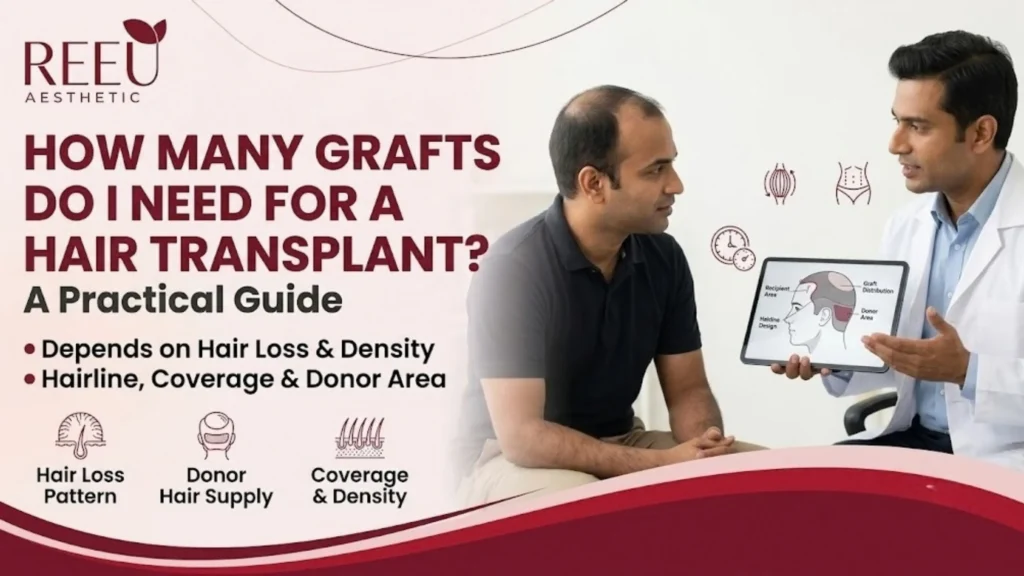




If you are planning a hair restoration procedure, one of the first questions you will ask is, “how many grafts do I need for a hair transplant?” It is a smart question, because the graft count affects the coverage you can expect, the cost, the length of the surgery and how much donor hair you keep in reserve for the future.
The honest answer is that there is no single number that fits everyone. Your graft requirement depends on the extent of your hair loss, your donor hair quality and the look you want. This guide explains how surgeons estimate it, so you can walk into your consultation well informed.
What Is a Graft in a Hair Transplant?
A graft is a small unit of tissue taken from the donor area, usually the back and sides of the scalp, that contains one to four hair follicles. Most grafts hold one to three hairs.
This is why graft count and hair count are not the same. A session of 2,000 grafts may carry roughly 4,000 to 5,000 individual hairs, depending on your natural follicular unit pattern. If you are new to the procedure, our page on hair transplant in Bhubaneswar explains how the process works from start to finish.
Average Graft Numbers by Stage of Hair Loss
Surgeons often use the Norwood scale to classify male pattern baldness. The ranges below are general estimates only. Your actual number will be decided after an in-person assessment.
- Early thinning or a slightly receding hairline (Norwood 2–3): about 1,000 to 2,000 grafts
- Moderate loss at the hairline and temples (Norwood 3–4): about 2,000 to 3,000 grafts
- Advanced loss with a crown and frontal thinning (Norwood 5): about 3,000 to 4,000 grafts
- Extensive baldness (Norwood 6–7): about 4,000 to 5,000 grafts or more, often across more than one session
For women, hair loss is usually diffuse thinning rather than a receding pattern, so the graft requirement and planning are different.
Factors That Decide How Many Grafts You Need
1. Size of the Area to Be Covered
The larger the bald or thinning area, the more grafts it takes to cover it. A small frontal patch needs far fewer grafts than a full top-and-crown restoration.
2. Hair Density Goals
Natural scalp density is about 80 to 100 follicular units per square centimetre in the donor area. Surgeons usually place grafts at a lower density in the recipient area, because very tightly packed grafts can reduce blood supply to the transplanted follicles. Your goal, whether natural-looking coverage or maximum density, shapes the plan.
3. Donor Hair Availability
Your donor area is a limited resource. Only a certain number of grafts can be harvested safely without leaving the donor area thin or patchy. If your donor supply is modest, a good surgeon will spread it wisely instead of using it all in one go.
4. Hair Characteristics
Thick, coarse and wavy or curly hair gives better visual coverage per graft than fine, straight hair. Hair colour and its contrast with your skin tone also affect how dense the result looks.
5. Age and Future Hair Loss
Hair loss is often progressive. A younger patient may need a conservative plan so that enough donor hair remains for later sessions as the pattern advances. This is also why medical treatment is often advised alongside surgery, and our guide to hair loss treatment in Bhubaneswar covers the non-surgical side.
Can You Get a Natural Result With Fewer Grafts?

Yes, in many cases. A natural-looking result depends on design and placement as much as on quantity. The hairline shape, the direction and angle of each graft, and the use of single-hair grafts at the front edge all matter a great deal.
Using more grafts does not automatically give a better result. Poor placement with a high graft count can still look unnatural. This is why the surgeon’s planning and experience matter. You can read about the surgeon’s background on the our surgeon page.
How Much Can the Donor Area Safely Provide?
Most people have a lifetime donor capacity in the range of several thousand grafts, though it varies widely from person to person. Overharvesting can leave visible thinning at the back of the scalp, which is very hard to correct.
A responsible plan keeps a safe reserve. For example, if you are in your twenties with early hair loss, using all of your donor hair now could leave you with no options if the loss progresses.
Are Supportive Treatments Useful Before or After Surgery?
Many patients combine a transplant with supportive therapies that may help improve hair quality and support existing hair. Options such as PRP therapy and GFC therapy are commonly discussed for this purpose. Procedures like mesotherapy and microneedling may also be suggested depending on your scalp condition. Results vary from person to person, so ask your doctor which approach suits you.
If you do not have enough donor hair, or you want the look of a closely shaved head, scalp micropigmentation can be an alternative or a complement to a transplant.
How Is the Graft Number Finalised at a Consultation?
During your consultation the doctor will usually:
- Examine your scalp and hair loss pattern
- Check donor hair density, thickness and quality
- Discuss your expectations and the hairline design
- Review your medical history and any ongoing hair loss treatment
- Give you an estimated graft range and explain whether one or more sessions may be needed
Be cautious of any clinic that quotes an exact graft number over the phone or from a single photo. A reliable estimate needs an in-person examination.
Common Myths About Graft Counts
Myth: More grafts always means a better result. Quality of planning, placement and donor management matters more than a bigger number.
Myth: Everyone with the same baldness stage needs the same grafts. Hair thickness, density and scalp size make every case different.
Myth: You can fix everything in one session. In advanced hair loss, a staged approach is often safer and gives a more natural result.
Final Thoughts
So, how many grafts do you need for a hair transplant? For most people the figure falls between 1,000 and 4,000 grafts, but your own number depends on your hair loss stage, donor strength and goals. The best way to get a reliable answer is a personal assessment with an experienced surgeon.
If you would like a personalised graft estimate, you can book an appointment for a consultation. You can also see more of our work on the gallery page or read what patients say on the testimonials page.
Disclaimer: This article is for general information and does not replace medical advice. Results vary from person to person. Please consult a qualified doctor for an assessment.
Frequently Asked Questions
1. How many grafts are needed for a full head of hair?
A truly full head of hair is usually not possible with transplantation alone, because donor hair is limited. Surgeons aim for natural-looking coverage in the most visible areas, such as the hairline and frontal zone.
2. Is 2,000 grafts enough for a hair transplant?
For early to moderate hair loss, especially at the hairline and temples, 2,000 grafts can give good frontal coverage. Larger areas need more.
3. Can I get a second hair transplant session?
Yes, if you have enough donor hair left. A second session is often planned after the first result has fully matured.
4. Does the number of grafts affect the cost?
In most clinics, yes. Cost is usually linked to the graft count or the extent of the procedure, so a clear estimate after consultation is important.
5. How long does it take to see results?
Transplanted hair typically sheds in the first few weeks, then regrows gradually. Visible growth often starts around three to four months, with fuller results over about 12 months.